
Podcast: Play in new window | Download
Subscribe: Apple Podcasts | RSS

Jason Noel –
Fat Fender Garage:
The 20-Year Overnight Success
Jason Noel is our guest today, founder of Fat Fender Garage in Gilbert, Arizona, and if you’re expecting the usual “born with a wrench in his hand” origin story, you’re about to get something better. This one has the arc of a great comeback film — family, struggle, heartbreak, reinvention — and the kind of grit that only comes from getting knocked all the way down and deciding you’re not staying there.
Jason didn’t grow up as the young gearhead craving horsepower the way so many of our guests did. His early car memories revolve around a 1966 Volkswagen Beetle with something like 50 horsepower and the kind of fearless confidence only an eighteen-year-old can possess. Back then, if it ran, it was going to take you anywhere. Today? He laughs at that thought. But those road trips mattered, because they were the first tiny thread connecting him to the feeling that machinery can represent freedom. He just didn’t know yet where that thread would lead.
Because for Jason, the first love wasn’t cars — it was craft. He’s a woodworker by origin. Finish carpentry was his lane: crown molding, doors, trim work, the details people don’t notice until they’re done wrong. And if you’ve ever been around a real finish carpenter, you know the mindset. The measurements aren’t just measurements — they’re standards. “Perfect is close enough,” he says. But he also knows the other side of that coin, the one every business owner eventually learns: sometimes “close enough is perfect” if you want to keep the lights on. That balance between precision and progress becomes a theme in his story, and it’s a theme that explains Fat Fender Garage more than any mission statement ever could.
Then came 2008 and 2009 — the housing crisis that didn’t just shake the construction world, it shattered it. Jason got wiped out. Business. Marriage. The foundation. The whole thing. And when you lose everything once, you rebuild differently the next time. You don’t rebuild for appearances. You rebuild for survival. You rebuild for control. And that’s where the path bends toward trucks, hot rods, and an “overnight success” story that took twenty years to earn.
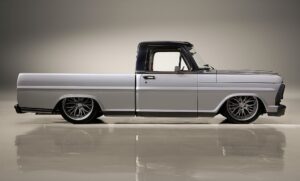
The first truck wasn’t even his. His father-in-law had someone repay a debt with an old pickup, and the ask was simple: “Want to help me fix this up a little?” The plan was a wood bed. That was Jason’s comfort zone. But one truck turned into another. And then another. They’d clean them up, fix what needed fixing, sell them, make a little profit, and do it again. They flirted with cars along the way — a ’57 Thunderbird, a ’67 GTO, even a ’58 Impala big enough to qualify as waterfront property — but Jason kept coming back to trucks. The shape, the simplicity, the purpose, the personality. Eventually he narrowed in on what felt right to him: 1953 to 1956 Ford pickups, with the ’56 being his personal favorite. He didn’t just like them; he resonated with them. He found a niche because his taste naturally led him there.
Then a customer showed up and asked him to build one for hire.
That’s when the romance ends and the real work begins. Building for yourself is one set of problems. Building for a customer introduces a whole new equation: expectations, opinions, and the pressure of trying to make someone else happy with a vision you might not even agree with. Jason’s first customer build went sideways because he said yes to everything, including ideas that didn’t belong together — the automotive equivalent of making chocolate chip cookies with the wrong ingredients and then being surprised they taste weird. The truck got finished, but nobody won. And that’s a moment that breaks a lot of people. For Jason, it became the lesson that shaped everything after it: you can’t be great if you can’t say no.

The next customer project went better, and then the story hits the moment that starts to define Fat Fender’s reputation. They moved into modern swaps. Fuel injection. Coyotes. The kind of work where there wasn’t a manual, there wasn’t a kit, and there definitely wasn’t a safety net. Jason will tell you he hadn’t done it before — and he’ll also tell you he said yes anyway. That might sound reckless until you understand what made it work: he wasn’t saying yes because he was careless; he was saying yes because he refused to stop learning. And in the process, Fat Fender became known early as one of the shops putting Coyotes into F-100s, figuring it out in real time, sharing what they learned, and inadvertently helping build a wave that now feels obvious — but wasn’t obvious when they started.
And here’s where the business side gets fascinating. Because as they did more builds, they kept running into the same problem: the parts and services they needed either didn’t exist, weren’t good enough, or couldn’t be delivered on any schedule that made sense. If you’ve ever built anything at a high level, you know exactly what I mean. You’re only as good as the slowest vendor you depend on. Jason realized that if he wanted Fat Fender builds to hit his standards — and hit timelines customers could live with — he had to take control of the process. That’s the real story of their vertical integration. It didn’t come from ego. It came from necessity. Body and paint came in-house. Upholstery came in-house. Parts came in-house. And once you start pulling those pieces under your roof, you stop being “a shop” in the traditional sense and start becoming something else: a company that can deliver the full experience.
Today, Fat Fender Garage is operating in a lane that’s growing slowly but steadily right alongside the muscle car world — the high-end classic vehicle custom space where builds are so comprehensive they start to resemble a low-volume production model, even when they aren’t technically “production cars.” They’re doing full builds now. They’ve largely stopped taking on small one-off jobs, and Jason explains why in a way that will make every shop owner nod: the little projects tie up space, stall momentum, and turn your floor into a storage unit while you wait on parts. At some point you either become a repair shop, or you become a build shop. Fat Fender chose the latter.
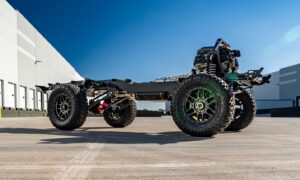
And then there’s the biggest swing of all: chassis. Not just buying chassis — building them. Designing them. Owning the intellectual property. Stepping intentionally into competition with the biggest names in the game, because Jason isn’t interested in “good enough” spec frames with yesterday’s thinking. He’s obsessed with fit, finish, rigidity, and options — the kind of options truck guys actually care about: ride height choices, legit four-wheel-drive capability, big brake packages, and modern features that are becoming the dividing line between “restomod” and “world class.” He wants control because control is how you guarantee quality. And because, in his words, somebody should challenge the top dog. So he raised his hand.
This is where you step back and realize what Fat Fender really is. It’s not just a restoration shop. It’s not just a parts manufacturer. It’s not just a content brand. It’s all of those things moving in the same direction — and it’s driven by a guy who learned the hard way that stability comes from owning the pieces you can’t afford to leave to chance. They’ve grown to a team of 75 people, including in-house engineers using SolidWorks, and the scale of what they’re building now is a far cry from flipping one old truck for fun.
And the best part? Stick around to the end of the interview, because the conversation takes a turn that should make every muscle car listener perk up. Fat Fender isn’t staying only in the truck world forever. They’re looking at cars too — and the next chapter might surprise you.
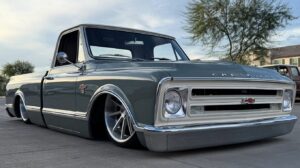
You can find more from Fat Fender Garage on their website at FatFender.com and across social, especially YouTube — where Jason’s “tell the story” approach is bringing in real organic leads because it isn’t just content, it’s education. And if you’re into classic trucks, modern swaps, high-end builds, or the reality of how a business grows from the ashes into something formidable, you’re going to want to hear this one.
You can find out more on the socials at
Instagram.com/FatFenderGarage
Facebook.com/FatFenderGarageAz.
For full videos and how-to content, head to
YouTube.com/@FatFenderGarage
And when you’re ready to order parts, start a build, or just do a little bench-racing and dreaming, visit
FatFender.com.
___________________________________________________________________________________________________________________________________________________________________________
This interview sponsored by our pals at National Parts Depot –
your premier source for muscle car restoration parts!